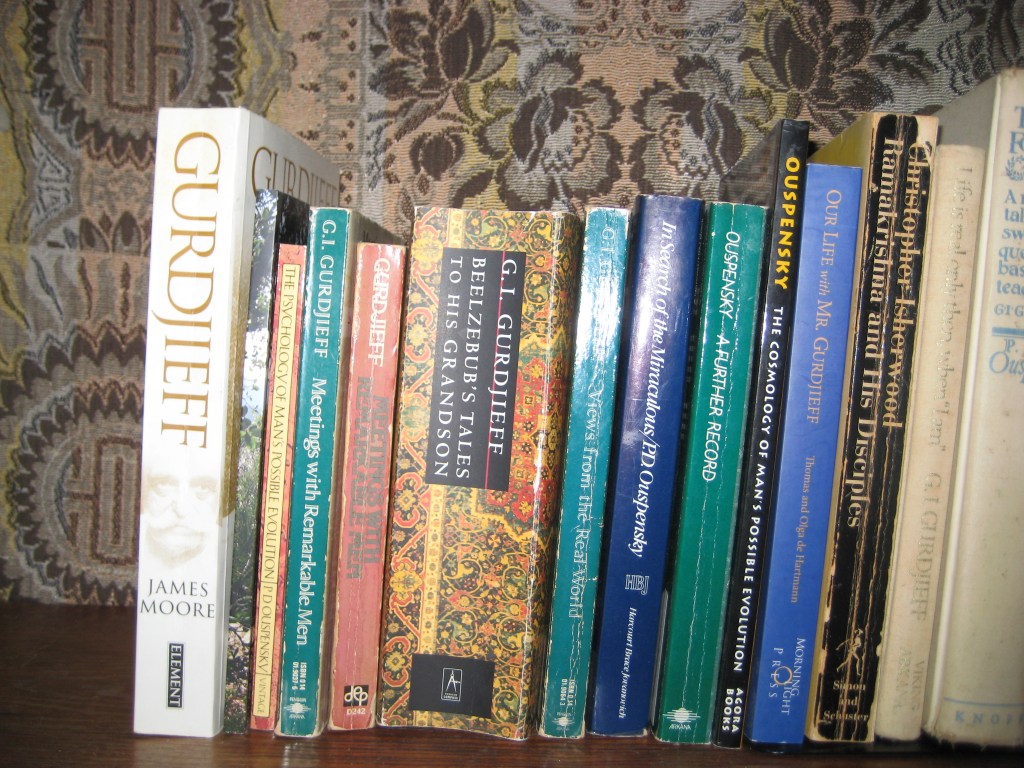
Each of these books has vital information but also an abundance of flaws, which is the primary reason the present book was written. Those who are interested in going deeper into the history and techniques of consciousness work may find some of the books listed here instructive or entertaining.
Learning To Be Conscious. D.A. Collins. Amazon, 2018 – The Kindle or paperback form of the book exactly as it is presented free on this web site. Traditional meditation, doing nothing, sitting still in silence with closed eyes and watching your breathing, is boring and time consuming. Soaring beyond mindfulness, Gurdjieff and Ouspensky’s methods use normal daily life and self-verified experiences to build higher consciousness. Their dynamic system is explained here in modern terminology and outlined in clear, sequential steps to enable a quick understanding of this accelerated path. The clarity of this book is strengthened by avoiding the wordiness, symbolism, and vagueness that have bogged down other books on these methods. At the end of each chapter, its main points are highlighted, exercises are given to put the specific ideas into practice, and a glossary is included for all new concepts. Terms are explained in commonly used language. Exercises are clear and simple. One step logically leads to another. All information can be self-verified.
Fourth Way Books by Ouspensky
In Search of the Miraculous. Ouspensky, Peter D.,Harcourt, Brace, 1949 – Reads like an astonishing novel, giving an in-depth look at the young Ouspensky interacting with Gurdjieff and his early methods and students. Very atmospheric with the tumult of the Russian Revolution and Ouspensky’s search for meaning. The basics of the Fourth Way system are entwined with adventure and mysterious events. A must-read for anyone wanting to know Gurdjieff and Ouspensky and their times. Mystical and informative. Like many books of the era, the volume is quite text dense. It is filled with occult terms and diagrams that are enormously and unnecessarily complicated. These contain elements of truth which could be more easily attained without all the pseudo-scientific red herrings.
The Psychology of Man’s Possible Evolution. Ouspensky, Peter D.,Vintage, 1973 – The Fourth Way system in a succinct nutshell. Lays out each basic principle and practice in uncluttered and unambiguous language. This clarity and brutal honesty is condemned to repel most readers, whose egos will succumb to such a direct assault of truth. Also, the books’ simplicity will lead many to miss its astonishing and new perspectives.
The Fourth Way. Ouspensky, Peter D.,Vintage, 1971 – The best detailed and in-depth information on the techniques of Fourth Way. Topics are listed for each chapter, wherein Ouspensky gives lectures followed by numerous questions from his students. His answers are lengthy and detailed. The index is very useful for looking up methods or concepts you are stuck on to get clarity. An essential reference book. The book is text heavy. Some of the student questions seem irrelevant or silly. There is some meandering into occult symbolism.
Books on the Higher Emotional Field of Activity and Bhakti Yoga
Each of these volumes gives a unique perspective on the practices and experiences of Bhakti yoga, the higher emotional realm, and upward rising consciousness. The Ramakrishna books are dramatic and inspiring. Gopi Krishna and Sanella take an objective and scientific approach that is very instructive. All are vital and worthwhile reading for one who is experiencing higher emotions for the first time or curious about them. These do not give information on how to attain these states, but that can be found elsewhere.
Great Swan: Meetings with Ramakrishna. Hixon, Lex, Larson, 2002
Ramakrishna and His Disciples. Isherwood, Christopher, Vedanta Press, 1965
Kundalini: the Evolutionary Energy in Man. Gopi Krishna, Shambhala, 1997
Religious Literature
Christian contemplatives have long practiced forms of meditation that parallel the methods described in this book. When the Psalms, New Testament, or Gnostic Gospels are read from that perspective, they can be quite illuminating. St Teresa of Avilla vividly describes seven levels of consciousness. Thomas Merton sought to correlate the meditative practices of Christians and Zen Buddhists.
The Seven Story Mountain. Merton, Thomas, Mariner, 1999
Contemplative Prayer. Merton, Thomas, Image, 1999
Interior Castle. St. Teresa of Avila, Dover, 2007
Zen and the Birds of Appetite. Merton, Thomas, New Directions, 1968.
The Way of Zen. Watts, Alan, Vintage, 1999
The Yoga Sutras of Patanjali. Bryant, Edwin F., North Point Press, 2009. – Patanjali’s Yoga Sutras contain the entire map of possible human consciousness and makes for fascinating reading. The states he describes have to be experienced to be understood, though – and while the book is a fantastic intellectual exploration, it cannot replace actual practice
Books by Gurdjieff
Oddly enough, although the Fourth Way system originated with Gurdjieff, anyone knowledgeable about the methods would strongly discourage novices to read any of his books until they are very familiar with the techniques from other sources. Gurdjieff was intentionally misleading and did everything he could to deflect most seekers. Nearly all of his books are so cumbersome and offensive, only the most fervent Fourth Way devotees would be committed enough to plough through them. Some, like Beelzebub’s Tales to His Grandson, are written as a sort of mental exercise in attention to train the mind to hold a line of thought against all obstacles of the boring, bombastic, pointless, and absurd.
Meetings with Remarkable Men. Gurdjieff, G.I., Martino Fine Books, 2010 – Gurdjieff’s best coherent writing, it outlines the important events of his early life. Reads like a great travel and adventure story, but is most likely more allegory than fact. Probably the only book by Gurdjieff that could be endured or taken seriously by the majority or readers.
Books About Gurdjieff and Ouspensky
Most of these books have terrible flaws, usually being one student’s narrow perspective. None of them contain any useful information on techniques or methods. They can be historically interesting or entertaining, but virtually never instructive.
Our Life with Mr. Gurdjieff. deHartmann, Thomas and Olga, Harper and Row, 1983 – For those interested in the early history of the Fourth Way system, gives a detailed account of their escape with Gurdjieff from the Russian upheaval and the early days of the school in France.
1960s Books and New Age Books
Included here are some of the major influences on consciousness exploration of those eras. All worth a read for the context and background.
The Power of Myth. Campbell, Joseph, Anchor, 1991
Be Here Now. Baba Ram Dass, Lama Foundation, 1978
The Perennial Philosophy. Huxley, Aldous, Harper Perennial Modern Classics, 2009
The Doors of Perception and Heaven and Hell. Huxley, Aldous, Harper Perennial Modern Classics, 2009
The Psychedelic Experience: A Manual Based on the Tibetan Book of the Dead. Leary, Timothy, Kensington, 1995
 Fourth Way Exercises